351 Billion Reasons to Care: CA’s FY 26-27 Budget
Tax Revenues Higher than Expected
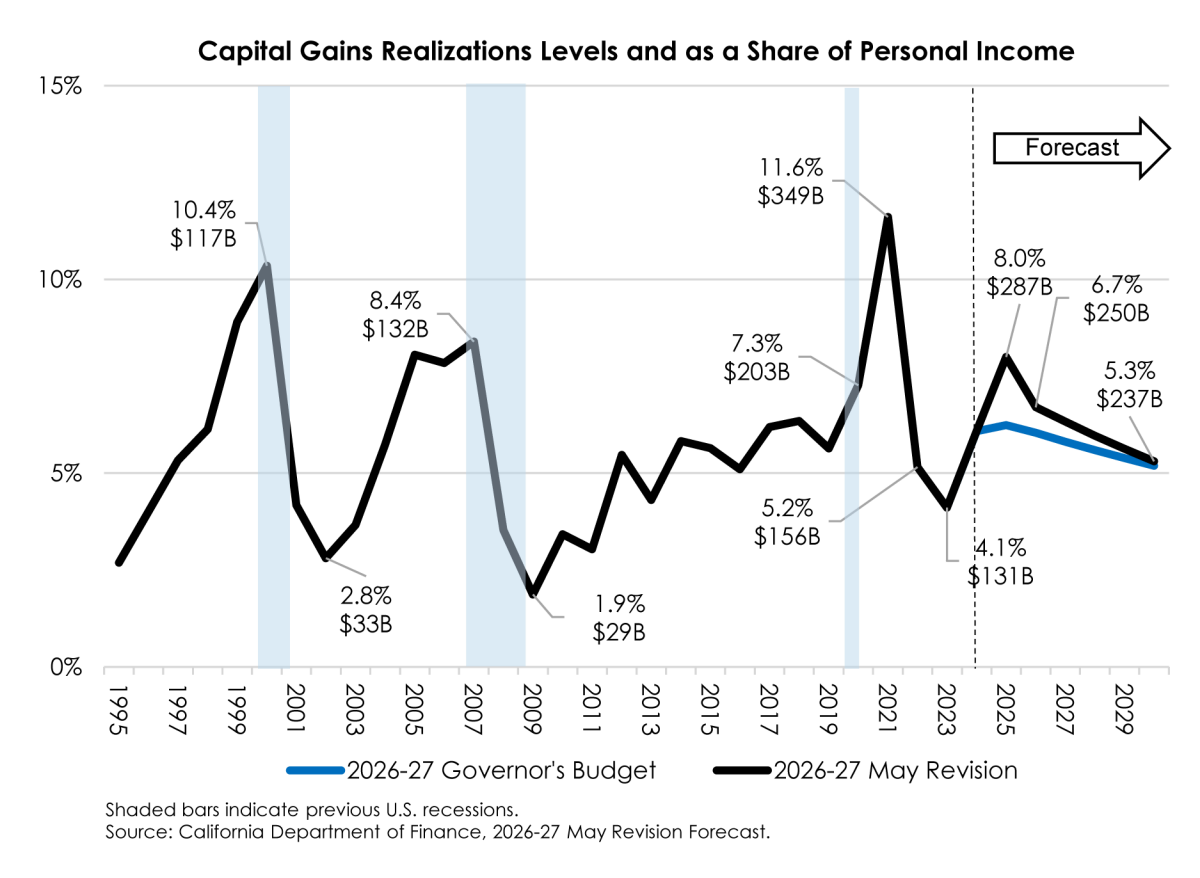
While the initial budget the Governor presented in January proposed $348 billion in total spending, it also projected a $22 billion deficit the following budget year, FY 2027-28, due to faster than expected spending growth, particularly from education and Med-Cal. However, the May Revise celebrated revenues exceeding forecasts by $16.8 billion, mostly due to personal income tax from capital gains, and proposed reducing the long-term structural deficit through roughly $5 billion in new revenues from limiting business tax credits, levying a new tax on pre-written business software and increasing the Managed Care Organization (MCO) tax.
But Future Deficits Still Loom
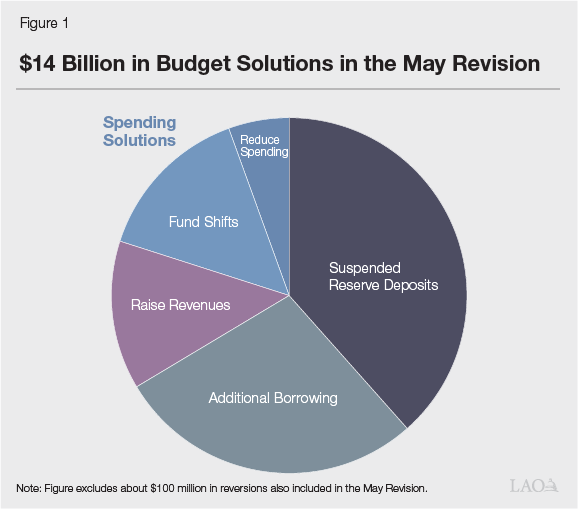
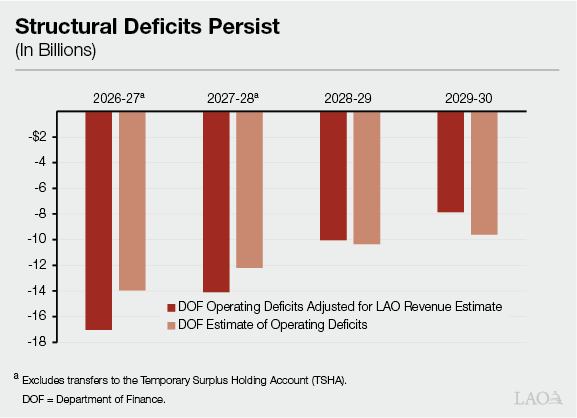
Although the higher than expected revenues allowed the Governor to propose more modest cuts totaling $411 million, the Legislative Analyst’s Office (LAO) pointed out that these, combined with the new revenues, would not completely solve the structural deficits still expected in future years. As a result, the state remains vulnerable to larger deficits should the stock market decline and reduce capital gains.
While Reserves Shrink
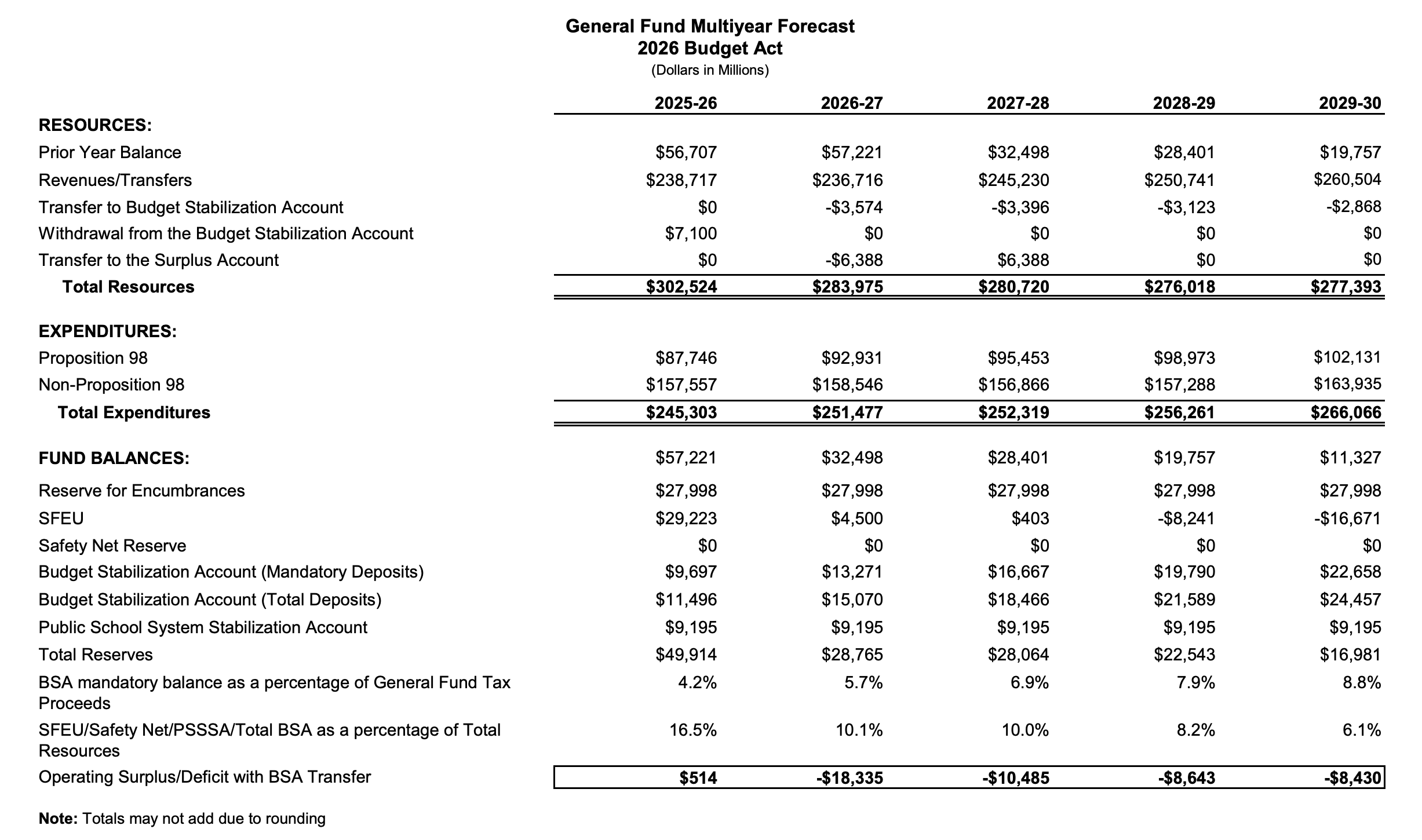
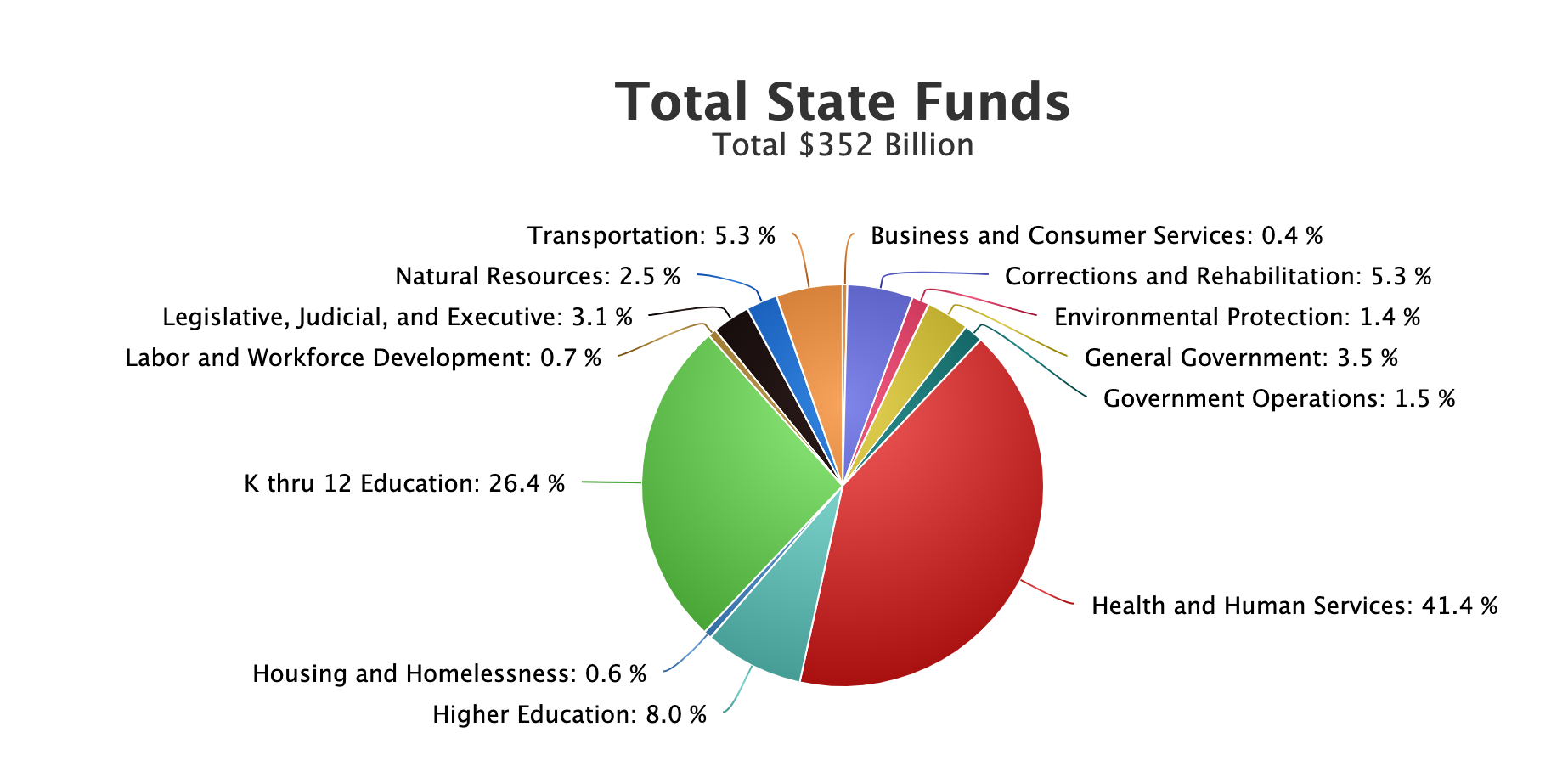
The ‘final’ budget signed in June outlines $351.7 billion, plus an estimated $187 billion federal funds, in spending, as the Legislature rejected or delayed many of the May Revise’s proposed cuts to In Home Supportive Services (IHSS) and Medi-Cal. The structural deficit, the difference between the state’s revenues and expenditures, remains, and as first outlined in the May Revise, the state will close the gap in FY 26-27 by depositing and then immediately withdrawing $6.38 billion from a recently created “Surplus Account” while suspending a $5.5 billion “true-up” deposit to the Budget Stabilization Account (BSA), the state’s “Rainy Day Fund.” As a result, the state’s total available reserves will drop from $49.9 billion in FY 25-26 to $28.7 billion in FY 26-27 and then further decline to 16.9 billion by FY 29-30.
Should the stock market decline significantly, deficits could be tens of billions of dollars larger. For example, although the LAO remarked that the FY 2019-20 budget was in “remarkably good shape,” the budget in the same breath cautioned that “even a moderate recession could result in revenue declines of nearly $70 billion and a budget deficit of $40 billion over three years.” One year later, a $5.6 billion projected surplus in the January 2020 budget proposal devolved into a $54.3 billion deficit during the COVID-19 recession.
Given this volatility is a predictable feature of CA’s progressive tax code that makes it especially dependent on personal income tax (PIT) from capital gains, the LAO has recommended the state hold much larger reserves, roughly $80 billion. ACA 20, to appear on the November 2026 ballot as Proposition 2, the “Save for California’s Future Act,” proposes to address this in part by doubling the BSA’s transfer cap from 10% to 20% of General Fund tax revenues, exempting these deposits from the State Appropriations Limit (SAL, or Gann Limit") and further increasing BSA transfer limits when PIT revenues from capital gains are higher than 8% of all General Fund Tax revenues. However, this still depends on voter approval and the next Governor’s willingness to eschew new spending in favor of replenishing reserves.
And Spending Outgrows Revenues
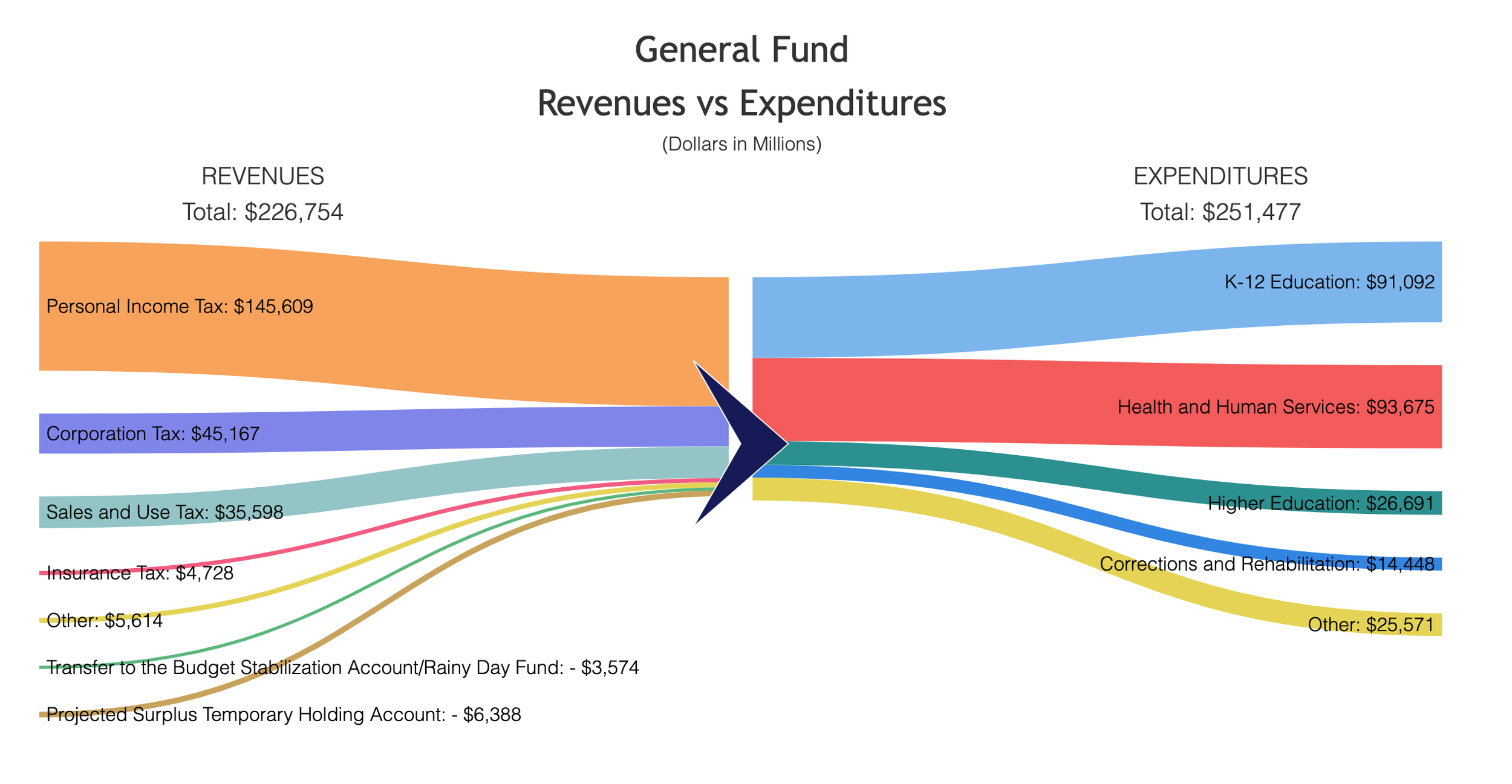
Parts of the 2026-27 budget remain under negotiation, to be implemented with budget trailer bills, and the next Governor will need to decide on a delayed premium hike for Unsatisfactory Immigration Status (UIS) Medi-Cal enrollees and propose a 'Freerider' tax for employers with large Medi-Cal enrollee populations as stipulated in AB 177, the “Fair Share from Big Corporations Act.” These decisions will depend in large part on how much tax revenues decline (or don’t) with the stock market, and each provide the Governor with options to raise new revenues as needed. However, it’s easy to see the structural deficit when we look at eBudget’s cash flow summary.
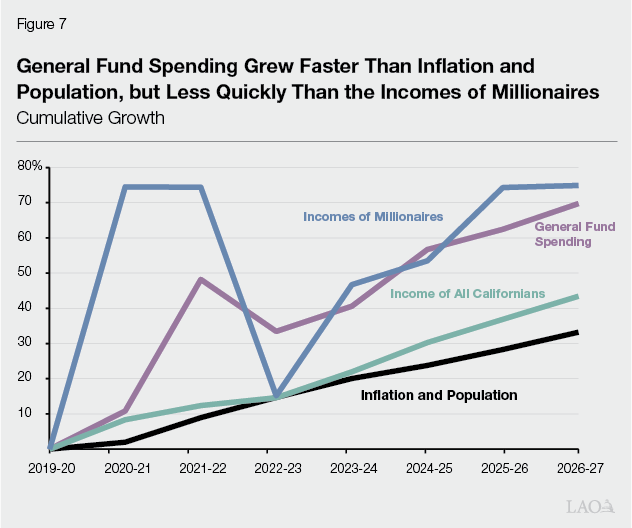
But how did we get here? By FY 2021-22, the LAO assessed that a “rapid but uneven recovery” indicated that the impact of the pandemic had not been “as catastrophic from a fiscal standpoint as the budget anticipated.” As a result, the Governor had a one-time $26 billion surplus to allocate, although the LAO forecasted deficits in the out-years growing to $17 billion by 2024-25 and warned that “the budget cannot afford any new ongoing augmentations.” Medi-Cal would account for 31% of this cost growth, while employee compensation would account for 10%. The Governor’s 2021-22 budget nonetheless expanded Medi-Cal coverage to UIS adults over 50 and augmented child care slots and CalWORKS benefits.
As the LAO noted “extraordinary revenue growth for the second year in a row” in 2022, the Governor had a one-time $52 billion surplus to allocate, and while only $2 billion was new ongoing spending, LAO projected this would more than double to $7.4 billion by 2025-26. Most of this growth would come from expanding Medi-Cal. Despite the projected growth and increasing risk of recession highlighted by the LAO, Governor Newsom’s FY 2022-23 budget further expanded Medi-Cal to UIS individuals 26-49.
Emblematic of post-pandemic economic volatility, the 2023-24 budget faced a $31.7 billion shortfall, which the Governor closed through fund shifts, delays, reductions or pullbacks of approved but not yet spent funds and internal borrowing rather than operations or program cuts. The LAO attributed the deficit to higher Federal Reserve interest rates due to continued inflation, which in turn depressed the stock market and the associated capital gains that comprise the bulk of CA’s personal income tax revenue. Further, the FY 2021-22 budget’s $3.4 billion in new ongoing spending was projected to grow to $12 billion by FY 2025-26, and the $2.4 billion of ongoing spending in the FY 2022-23 budget was projected to grow to $5 billion by FY 2026-27.
As the 2024-25 budget presented a $46.8 billion deficit, the Governor was forced to tap reserve funds and make deeper cuts, including a 7.95% reduction to “nearly all department budgets” for $2.17 billion and a ‘vacant position sweep’ for $1.5 billion. However, the LAO was skeptical that this level of savings could be reached and recommended using the exercise to identify specific opportunities for cuts rather than a general reduction.
The 2025-26 budget attributed a smaller $11.8 billion deficit to “slowed growth” due to “broad-based tariffs” as well as “substantial cost and caseload growth in several core state programs — most notably, in Medi-Cal [...]” which the Governor addressed by freezing enrollment in the previously approved Medi-Cal expansion to UIS adults, eliminating dental benefits for that population and reinstating a Medi-Cal asset test limit, among others. The $2.8 billion in reductions was projected to grow to $11.9 billion by 2028-29. However, the largest solutions were $6.6 billion in loans and $7.1 billion from the Budget Stabilization Account (BSA) previously approved in the 2024-25 budget.
As well, most bargaining units implemented a furlough program, PLP (Personal Leave Program) 2025, which exchanges scheduled pay increases for monthly accruals of leave. Once this program ends in FY 2027-28, however, the LAO notes that the increase in both pay rates and hours will “result in a relative jump in state salary-driven benefit costs.” This is exacerbated by all bargaining units suspending OPEB prefunding contributions for two years. The PLP and OPEB contribution suspension will save the state $1.365 billion in FYs 2025-26 and 2026-27 but cost the state $1.759 billion in FY 2027-28, an approximately $394 million net loss.
$100 Billion More Spending since 2019
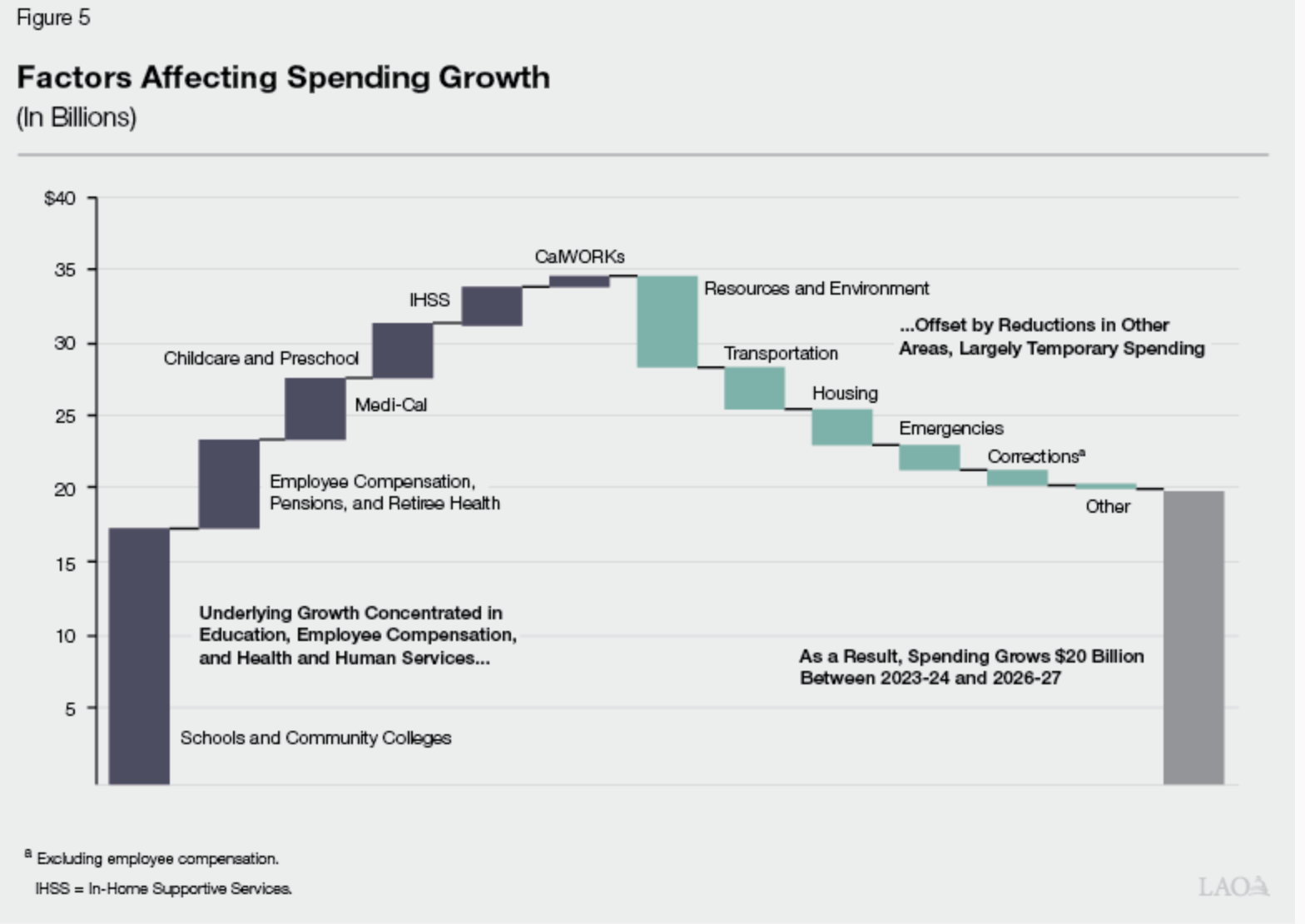
After its repeated warnings against any new ongoing spending went unheeded for several years, the LAO in April 2026 published a more comprehensive retrospective on spending growth: “Understanding $100 Billion in Spending Growth: Causes and Fiscal Implications”. Somewhat surprisingly, although new programs contributed a significant share of spending growth, most came from existing programs, especially healthcare, which the state funds through “Local Assistance” to counties and cities.
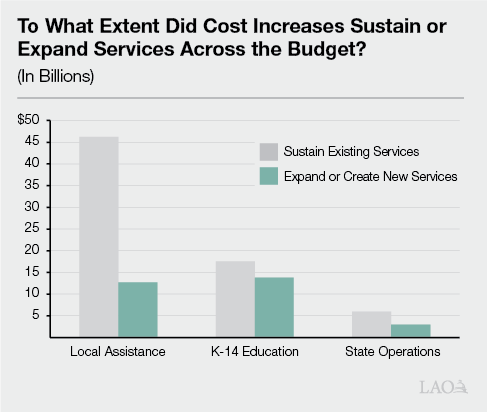
The LAO found that a few programs accounted for most growth:
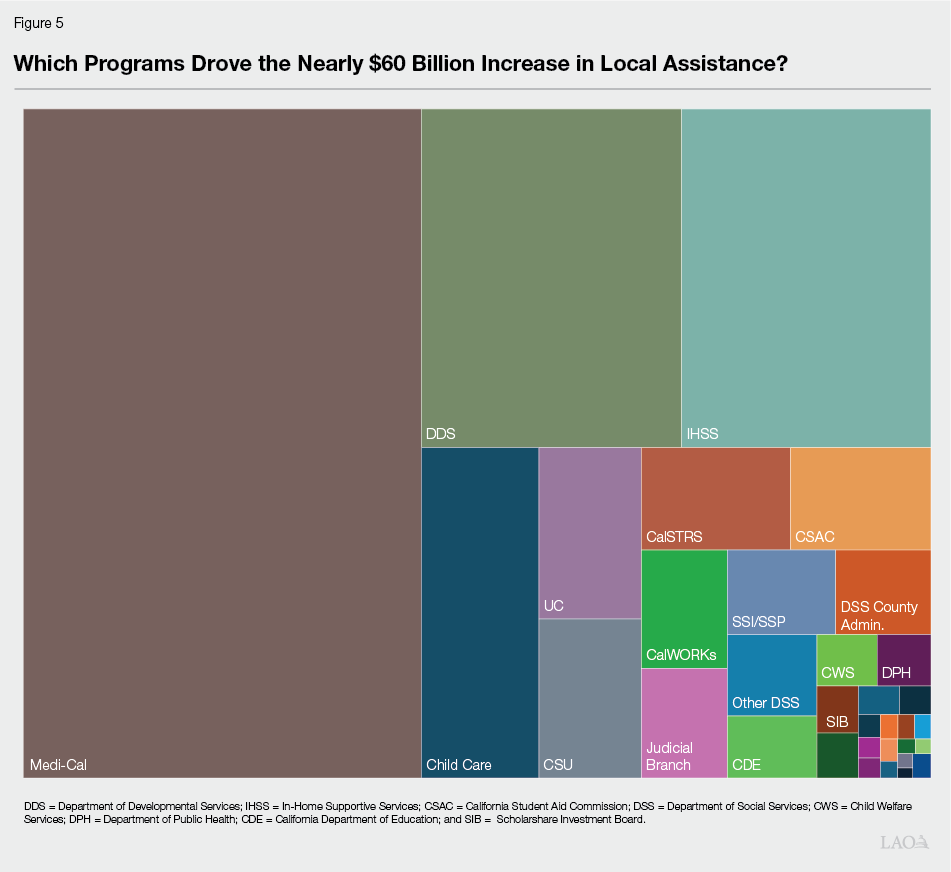
$37 billion from schools and community colleges
$25 billion from Medi-Cal
$8 billion from Department of Developmental Services
$8 billion from In-Home Supportive Services (IHSS)
$4 billion from child care
$3 billion from UCs
Since school funding is enshrined in the state constitution with the Prop 98 “minimum guarantee,” the Legislature and Governor have much less latitude to adjust school funding than other programs, except that since nearly half of K-14 spending growth came from new programs, they could have chosen not to authorize them.
Interestingly, healthcare expenditures grew not only from increased enrollment, but also because enrollees used more services during an extra inflationary period. Med-Cal enrollees in particular had a higher per capita cost due to more expensive pharmaceuticals and higher provider rates, and these cost increases outweighed the relative increase from larger enrollment.
In sum, the budget has once again navigated significant uncertainty and avoided the most painful cuts with a stroke of good fortune in the form of an inexplicably resilient stock market. However, future budgets face substantial risk, as no stock market remains strong all the time. When (not if) the state faces the next tax revenue downturn, the best possible position will be to have reserves ample enough to maintain current spending as well as options to curtail spending that has proven ineffective or unnecessary. As we pointed out in our last post, though, policy evaluation for outcomes and cost effectiveness is still under development in CA, and policymakers may find more value for their constituents in deeper oversight of existing programs rather than creating new ones.
