Is Our Laws Learning?
Policymakers and advocates in Sacramento are digesting the initial $248 billion FY 2026-27 budget Governor Newsom submitted in January, and nobody is eager to make the tough decisions required to put the state on stable financial footing over the long-term. Although unexpectedly large personal income tax revenues from frothy AI tech stock capital gains will allow the Governor to avoid large spending cuts or tax increases this fiscal year, tax revenues inevitably will fall from their current high water mark, and the state won’t have enough to fund its expenditures. Again.
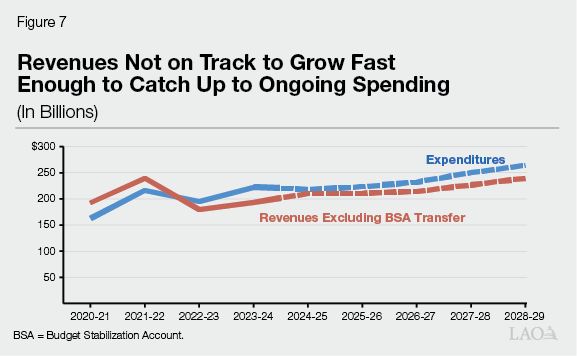
The Legislative Analyst’s Office (LAO) has been making this case since its FY 2025-26 Fiscal Outlook published in November, 2024, yet neither the Governor nor the Legislature has meaningfully addressed this structural deficit. Rather, a new $21 billion “Wall of Debt” has been the primary tool to address recent budget deficits.
This begs the question: “What government activities are a priority, and how do we pay for them?” That same year, the LAO published a handy guide on “Undertaking Fiscal Oversight” to do just that. Unfortunately, the LAO dampens its oversight guide with a major data caveat:
Evaluating Program Success Challenging. Identifying the effect of state programs on key outcomes of interest is often challenging because it usually requires in-depth research to determine whether state funding—or some other external factor—is driving the observed trends. In many cases, this type of research does not exist. As a result, rarely is information available to determine whether a state program was the cause of a particular change or outcome. In some cases, however, basic data tracking of high-level outcomes and/or metrics of program delivery are available. For example, programs typically have information about the rate of expenditure, number of people served, and services provided. While these metrics provide important insights into programs, they often only provide indirect evidence of programs’ success.
I’m extraordinarily fortunate to do some of this work for clients interested in specific policy areas, though my resources are sorely limited next to the government’s, and I’ve experienced firsthand many times the bureaucratic shrug in response to requests for expenditure and program information. Some of these gaps are more surprising than others.
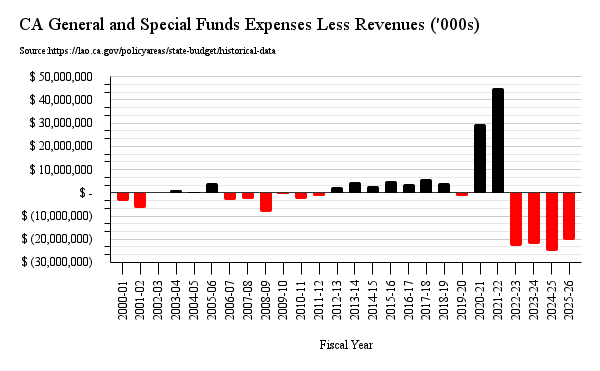
For example, this chart is meaningless. Because budgets are continuously evaluated and updated over a 3 year window, expenditures and revenues often shift between years after the fact. That means that it is not possible to look at a given fiscal year and even say if the state government spent more money than it collected.
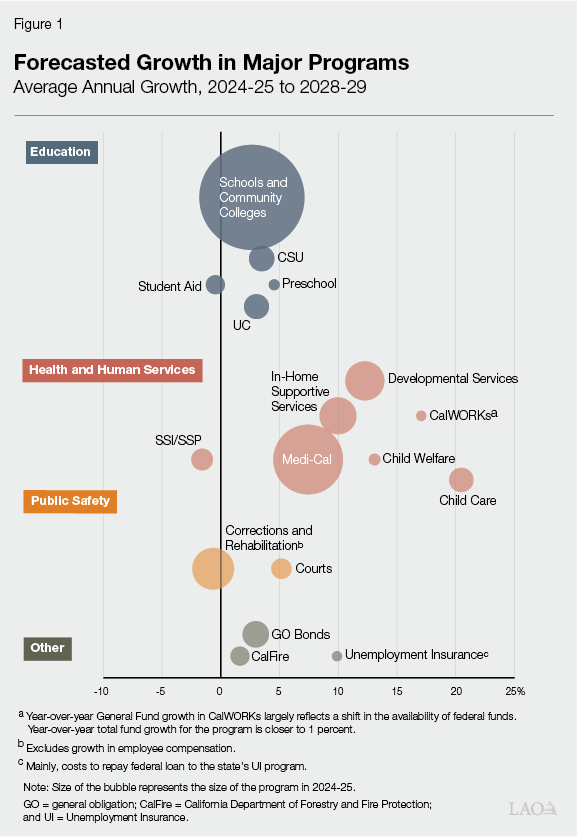
That said, the LAO is doing what it can to make sense of the state’s spending growth major components to orient policymakers to the primary areas that will require either new revenues or spending reductions to avoid chronic structural deficits.
But how are we to dig further into to these policy areas to understand what state funding is accomplishing and, more importantly, what benefit it’s bringing to Californians? At least one positive development is Speaker Rivas’ Outcomes Review for a select set of past legislation, though it remains to be seen what results will come from these self-administered evaluations. As well, it’s unclear how much this approach could scale up in the future to cover these vast, diverse topics.
If you’re asking yourself why outcomes review for legislation it isn’t already standard procedure to benefit from a continuous learning feedback loop, let me introduce Proposition 140 (1990). In many ways, Prop 140 was a backlash against Willie Brown’s stubborn, entrenched power in Sacramento and successfully channeled voter frustration into strict limits on legislative terms, benefits and spending. Besides stripping pensions from Legislators, Prop 140 slashed legislative spending on compensation and operations to 80% of the previous year’s amount and limited future growth to the state’s appropriations limit growth, which is calculated using cost-of-living and population in order to “keep real (inflation adjusted) per-person government spending under 1978-79 levels.”
While in 1990 it may have seemed that the legislative branch of California’s state government had reached its nadir in 1978, today in practical terms it means that the Legislature is unable to dedicate significant additional resources to policy research and oversight even if it wanted to do so. The logical choice to do this work would be an independent office like the LAO, but as the LAO’s funding falls under the Legislature, it was cut significantly by Prop 140 and remains severely limited.
As Prop 140 reform is not necessarily at the top of anybody’s list to push through the arduous and eye-wateringly expensive ballot measure process, we will likely need to make do for the foreseeable future with the handful of good government organizations willing to dedicate their own resources to independent policy research and evaluation. Still, it’s nice to know that we could take a more results-oriented, data-driven approach to passing laws and administering government programs in California should the political will for it ever materialize.
